By: Dr. Lingfei (Teddy) Wu
Artificial Intelligence (AI) is revolutionizing the legal industry, meeting the growing demands for efficiency, accuracy and speed in handling increasingly complex legal matters. Traditional methods are no longer sufficient with AI becoming an indispensable tool for legal professionals to improve productivity, reduce costs and enhance client satisfaction.
According to recent studies, 73% of legal professionals plan to incorporate general AI tools into their practice within the next year (Kluwer, 2023). This statistic underscores the shift in perception surrounding AI. Legal professionals now see AI as a critical tool, not just for future planning, but for immediate implementation.
Enhancing Legal Workflows with AI Tools
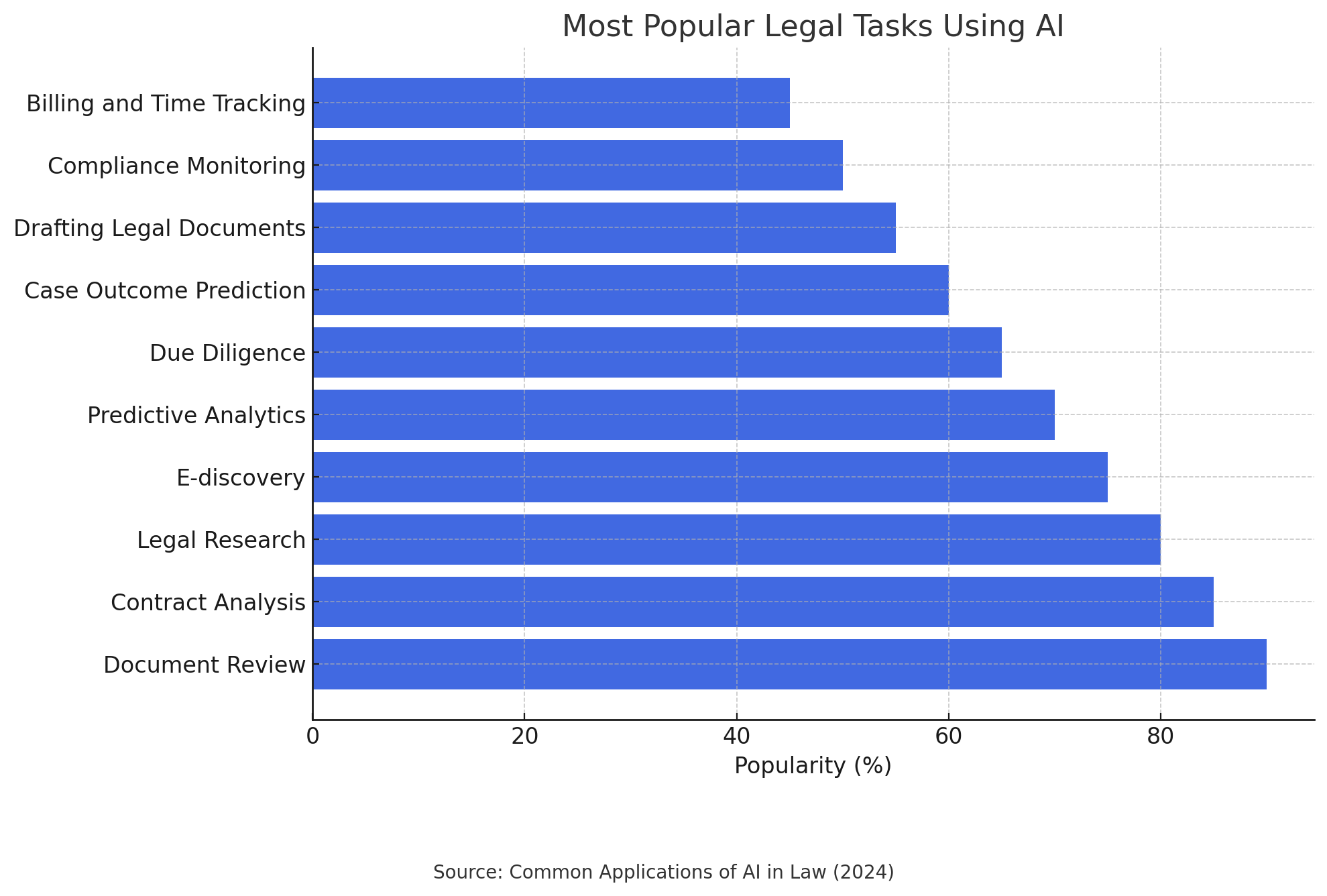
AI is revolutionizing legal workflows by improving the speed and accuracy of routine tasks. What once took days or hours can now be accomplished in minutes, creating a more streamlined and cost-effective process. The following tasks have been streamlined as a result of AI:
- Document Review and Summarization
Document review has historically been one of the most labor-intensive tasks for legal professionals, requiring hours of manual work, sorting through large amounts of paperwork. AI can now review and summarize documents in a fraction of the time, identifying relevant information and flagging key points with high accuracy.
- Demand Letter Drafting
In legal drafting, AI has proven to be equally effective. AI tools can generate initial drafts of legal documents, such as demand letters, allowing lawyers to focus on fine-tuning and customization.
- Deposition Summarization
AI also significantly reduces the time spent summarizing depositions—a process that previously required substantial manual effort. Now, AI tools can generate detailed summaries almost instantaneously, making critical information more accessible.
- Medical Record Analysis
In personal injury cases, where medical record analysis can be complex and time-consuming, AI steps in to simplify this process by summarizing medical data in minutes. This enables legal professionals to review important case information without the time-consuming manual effort.
These advancements show how AI is reshaping legal practice by automating time-consuming tasks and allowing lawyers to focus on higher-level, value-added activities.
Addressing the Challenges of AI in Law
While AI provides undeniable benefits to the legal sector, there are challenges that must be addressed to ensure reliable AI usage. One major concern is "AI hallucinations," where AI systems may generate incorrect or misleading information. To mitigate this risk, legal professionals need to establish robust validation processes to confirm the accuracy of AI-generated outputs.
Another key concern is ensuring data security and client confidentiality. AI systems handling sensitive legal information must be built to comply with stringent privacy regulations, safeguarding client data from potential breaches.
Ultimately, successful implementation of AI in law requires using Large Language Models designed for legal reasoning, combined with workflows tailored to specific legal tasks. This approach ensures that AI tools are accurate, secure, and aligned with the unique demands of the legal profession.
The Future of AI in Law: Embracing Innovation
AI is transforming the legal industry by improving operational efficiency and enabling greater client outcomes through task automation. Legal professionals must adopt AI to remain competitive, boost client satisfaction, and excel in an increasingly digital landscape. Those who leverage this technology will position themselves to shape the future of the legal industry.
Dr. Teddy Wu, CEO and Cofounder of Anytime AI, is an AI engineer with a Ph.D. in computer science. He has held senior positions at Pinterest, JD.COM, and IBM, authored over 100 papers, published a widely read book on Graph Neural Networks, and holds 65 patents. He can be reached at lwu@anytime-ai.com or 757-634-5455.



 MY NJAJ
.png)




%20(002).png)
.png)

.png)